Companion Article: For an architectural breakdown of why backup exit codes fail to guarantee recoverability, read Why a Successful Backup Job Doesn't Prove Disaster Recovery.
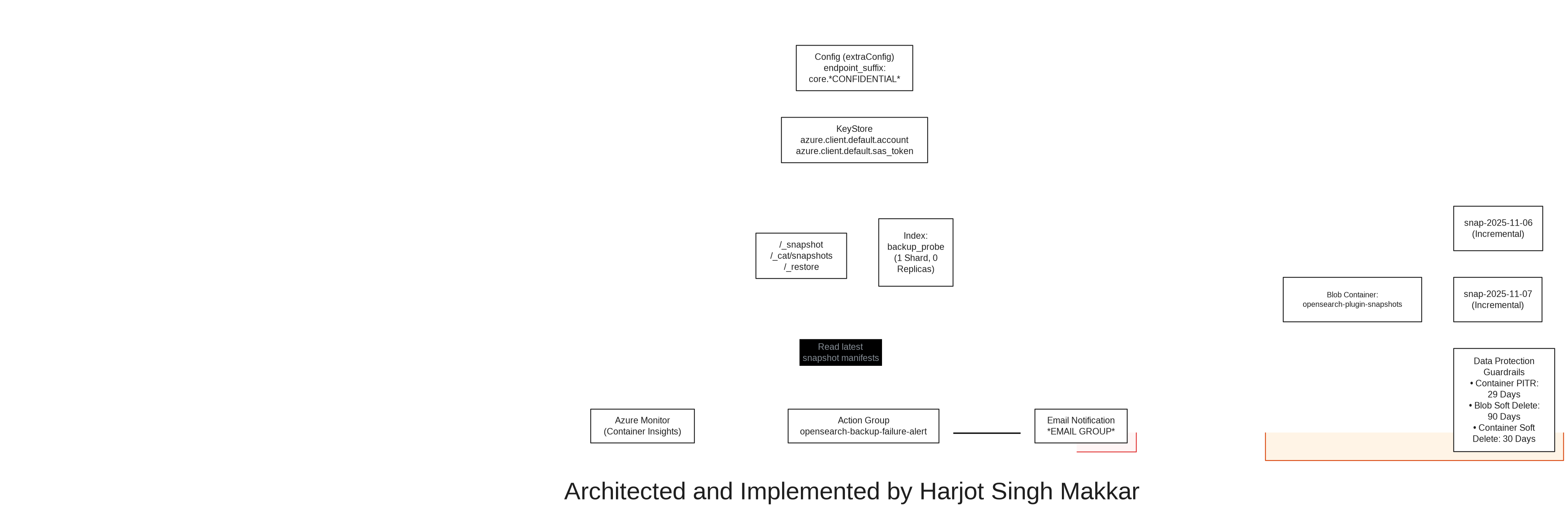
The platform protects OpenSearch across two complementary layers: combining full Kubernetes infrastructure snapshots with granular, per-index data snapshots, coupled with an automated daily restore-probe verification engine and proactive KQL alerting:
-
Layer 1: Cluster-Level Architectural Backup (Azure Backup Vault)
- Scope: Full AKS namespace protection covering StatefulSets, Deployments, ConfigMaps, Secrets, and Persistent Volume Claims (PVCs).
- Target Storage: Dedicated Azure Storage Account (enterprisestoreprod01) in an enterprise regulated cloud region.
- Frequency & Retention: Daily at 03:00 ET, retained for 30 days with Geo-Redundant Storage (GRS).
- Primary Purpose: Complete namespace restoration in the event of whole-cluster corruption, node pool loss, or disaster recovery re-provisioning.
-
Layer 2: Granular Per-Index Data Backup (repository-azure Plugin)
- Scope: Incremental, index-level OpenSearch snapshots written directly from cluster nodes into Azure Blob Storage (opensearch-plugin-snapshots).
- Authentication: Zero static credentials; SAS tokens injected into OpenSearch Keystore via pod postStart lifecycle hooks.
- Frequency & Retention: Daily at 02:00 ET, retained for 30 days via API-driven chain-safe pruning.
- Primary Purpose: Fine-grained, non-destructive recovery of individual indices, time-series partitions, or documents without cluster downtime.
-
Layer 3: Automated Verification Layer (opensearch-snapshot-verify)
- Scope: Scheduled Kubernetes CronJob executing 15 minutes after snapshot completion (02:15 ET).
- Mechanism: Restores an isolated verification probe index (backup_probe_verify_<snapID>), polls shard recovery until green, asserts document counts, and tears down the probe.
- Primary Purpose: Proves data readability and repository integrity every 24 hours, converting backup assumptions into verified recovery facts.
-
Layer 4: Continuous Observability & Alerting (Azure Monitor KQL)
- Scope: Azure Monitor Container Insights evaluating KubeEvents on a 5-minute sliding window.
- Mechanism: KQL query detects job execution failures (BackoffLimitExceeded, DeadlineExceeded, non-zero exit codes) and dispatches a single high-priority alert to SRE on-call engineers.
Snapshot files stored in object storage are vulnerable to accidental deletion, script misconfigurations, or lifecycle rule collisions that can silently break incremental snapshot chains. To eliminate storage-level points of failure, the following immutable safeguards are enforced on the target storage account:
- Point-in-Time Restore (PITR) for Containers: Enabled with a 29-day continuous rollback window, allowing instant recovery of the snapshot container if repository metadata is compromised.
- Soft Delete for Blobs: Configured with a 90-day retention window, preventing permanent deletion of incremental data segments even if a delete command is issued.
- Soft Delete for Containers: Configured with a 30-day retention buffer to safeguard against accidental storage container removal.
- Geo-Redundant Storage (GRS): Asynchronous cross-region data replication ensures complete disaster resilience against regional cloud outages.
- Incremental Chain Integrity: Storage-level safeguards guarantee that snapshot delta dependencies remain intact throughout rolling 30-day lifecycle windows.
While index snapshots preserve search data, they do not capture the surrounding Kubernetes topology. If an AKS cluster suffers control-plane failure, etcd corruption, or namespace deletion, operators must recreate StatefulSets, volume mounts, service accounts, and configurations before index data can be re-attached.
Azure Backup Vault provides full-cluster, namespace-level disaster recovery:
- Captures all Kubernetes objects across the opensearch-cluster namespace.
- Takes volume snapshots across all active Persistent Volume Claims (PVCs) underlying OpenSearch master and data nodes.
- Operates independently of OpenSearch internal API availability.
- Vault Configuration: Azure Backup Vault (enterprise-backup-vault-01)
- Protected Resource: enterprise-prod-aks-01/opensearch-backup-prod
- Cadence: Daily at 03:00 ET (07:00 UTC)
- Retention Policy: 30 Days (Rolling backup points)
- Storage Tier: Geo-Redundant Storage (GRS)
- Select Recovery Point: Navigate to Azure Backup Vault and select the target point-in-time snapshot.
- Execute Namespace Restore: Trigger Kubernetes Services Namespace Restore targeting the opensearch-cluster namespace.
- Verify Volume Attachments: Ensure PVCs bind to the restored storage disks and stateful pods transition to Running:
- Data Plane Re-Sync: Once Kubernetes infrastructure is restored, operators inspect /_cat/indices and use Layer 2 repository snapshots to replay any delta changes that occurred after the infrastructure volume snapshot.
While Layer 1 provides a safety net for full cluster recreation, restoring multi-terabyte PVC volumes to recover a single corrupted index is inefficient and causes unnecessary service interruption. Layer 2 writes index-level snapshots directly to Azure Blob Storage using the official repository-azure plugin.
Rather than maintaining custom Docker images that introduce maintenance overhead, the plugin is installed across all OpenSearch pods (master, data, ingest, coordinating) at container startup using a FluxCD HelmRelease patch:
Storing cloud storage keys in plain-text environment variables or config files introduces critical security vulnerabilities. To maintain strict zero-trust credential hygiene:
- The Kubernetes Secret os-az-creds is mounted into pods as a read-only volume (/secrets/az).
- During pod startup, a postStart lifecycle hook executes opensearch-keystore commands to inject the Storage Account name and SAS token into an encrypted, in-memory keystore:
The backup architecture separates snapshot creation from snapshot verification into two synchronized CronJobs managed under GitOps.
- Schedule: 0 6 * * * (02:00 ET / 06:00 UTC)
- Container: curlimages/curl:8.4.0
- Execution Script:
- Verifies that the dedicated backup_probe index exists (configured with 1 primary shard, 0 replicas).
- Upserts a live timestamp document to ensure active index writes.
- Executes a synchronous snapshot (wait_for_completion=true), explicitly excluding internal system indices (.opensearch*, .plugins*, .kibana*).
- Executes API-only retention pruning: queries snapshots older than 30 days and removes them strictly via DELETE _snapshot/azure-repo/<snap>, preserving the underlying incremental blob chains.
Most organizations stop at Step 3. As long as the backup CronJob exits with code 0, dashboards stay green.
However, in distributed search engines like OpenSearch, an exit code 0 can occur even if individual shards failed to flush, if underlying cloud storage suffered transient write timeouts, or if index metadata was corrupted.
- Schedule: 15 6 * * * (02:15 ET / 06:15 UTC - offset 15 minutes after snapshot initiation)
- Container: alpine:latest with curl and bind-tools
- Cluster Health & DNS Verification: Confirms internal Kubernetes DNS resolution and cluster status via /_cluster/health.
- Strict State Assertion: Inspects the latest snapshot state via curl -s "$OS_URL/_snapshot/$REPO/$LATEST". If the state is PARTIAL, FAILED, or IN_PROGRESS, the script immediately exits with an error.
- Repository Connectivity Probe: Calls POST /_snapshot/azure-repo/_verify across all nodes to ensure cloud container access is intact.
- Isolated Restore Execution: Restores the backup_probe index from the latest snapshot into an isolated throwaway index (backup_probe_verify_<snapID>):
- Shard Recovery Validation: Polls /_cat/indices/backup_probe_verify_* until the index achieves green status.
- Data Integrity Check: Executes a /_count query on the restored index, asserting that the document count is greater than or equal to 1.
- Clean Teardown: Deletes the throwaway test index via DELETE /backup_probe_verify_* and exits with code 0.
- Failure Handling: If any check fails, the pod terminates with an exit code of 1, triggering the Kubernetes job backoff limit and surfacing an alert to Azure Monitor.
To guarantee zero manual operational overhead while avoiding alert fatigue, alerting is built on top of Azure Monitor Container Insights via Kusto Query Language (KQL).
- Rule Name: opensearch-backup-failure[PROD]
- Signal Type: Container Insights Log Analytics
- Evaluation Cadence: Every 5 minutes (over a 5-minute sliding window)
- Severity: Critical (Sev 0)
- Suppression: Fires once per incident to prevent alert flooding
After months of stable operation, on August 13, 2026 at 06:00:07 UTC, the nightly production snapshot job experienced an unexpected partial failure. Two primary production indices (fileinfo_2 and testlog_2) failed to snapshot due to a sudden OpenSearch data node termination (node shutdown).
Fifteen minutes later, the verification CronJob ran, reported Completed, and exited cleanly. This created a false-positive recovery signal that initially masked the failure from Azure Monitor.
Querying the failed snapshot (snap-20260813-060002) revealed:
- Total Shards: 3
- Failed Shards: 2 (fileinfo_2 shard 0, testlog_2 shard 0)
- Successful Shards: 1 (backup_probe)
- Error Payload: "reason": "node shutdown", "status": "INTERNAL_SERVER_ERROR"
- Node Physical Hardware: 8 vCPU, ~32 GiB RAM (27,589,236 KiB allocatable capacity).
- Pod Density: 35 active containers scheduled on the single node.
- Allocated CPU Limits: 220% of node capacity (17,240m).
- Allocated Memory Limits: 125% of node physical RAM (35.4 GB limits vs. 27.5 GB allocatable).
- Off-Heap Lucene Memory Spike: While OpenSearch JVM heap was capped at 2g, Lucene leverages off-heap kernel page caches and native buffers during snapshot read operations. The concurrent reading of large index segments triggered a sharp memory spike beyond allocatable RAM.
- Kernel OOM Killer Invocation: Because the node was overcommitted to 125% memory, the kernel OOM killer terminated the OpenSearch process immediately (node shutdown).
- The False-Positive Blindspot: The original verification script only checked whether the backup_probe index could be restored. Because backup_probe was the very first index processed, its single shard landed in the snapshot before the data node crashed. When the verify script restored backup_probe, it found 1 document and reported success, completely blind to the fact that the two multi-gigabyte production indices had failed.
- Strict Shard-Level Snapshot Assertion: The verification script was upgraded to inspect the aggregate snapshot state. It now queries curl -s "$OS_URL/_snapshot/$REPO/$LATEST" | jq -r '.snapshots[0].state' and immediately aborts if the state is anything other than SUCCESS, catching all PARTIAL failures before any probe restore runs.
- Snapshot Bandwidth Throttling: To eliminate aggressive off-heap memory spikes during segment reads, snapshot bandwidth was throttled on the repository:
- Elimination of Node Overcommitment: OpenSearch data nodes were moved to dedicated node pools with pod memory limits capped at 85% of total allocatable host RAM, preventing multi-tenant eviction cascades.
- Post-Fix Verification: On August 14, 2026, the snapshot job completed cleanly with state SUCCESS across all shards, and the verification CronJob completed its restore probe with 100% data fidelity.
When restoring data to investigate an operational issue or recover an accidentally deleted index, operators must never overwrite active production indices. The following non-destructive rename restore pattern is standard procedure:
- Shard-Level Inspection: Inspect raw shard metadata via curl -s http://localhost:9200/_snapshot/azure-repo/<snap-id> | jq . to verify that "shards.failed": 0 and that all expected index partitions exist.
- Isolated Dry-Run Validation: Restore a production partition to a temporary name (dryrun_verify_$1), assert document parity, and delete the temporary index.
- Out-of-Band Staging Cluster Replay: Register the production Azure Blob Storage container on a staging cluster with "readonly": true to execute end-to-end recovery rehearsals without placing query or I/O load on the live production cluster.
- Zero-Touch Backup Reliability: Reduced daily backup management overhead to zero hours; the system runs, verifies, and alerts autonomously.
- Guaranteed Recovery Time (RTO): Full-namespace infrastructure recovery under 45 minutes via Azure Backup Vault; granular single-index restore under 5 minutes via repository-azure.
- Elimination of Silent Failures: The restore-probe verification CronJob eliminated the industry-standard false-positive blindspot where corrupted snapshots go unnoticed until disaster strikes.
- Regulatory & Compliance Defense: Multi-tier storage defenses (29-day PITR, 90-day blob soft delete, 30-day container soft delete, GRS geo-redundancy) fully meet stringent federal and enterprise audit standards.
OpenSearch · Kubernetes (AKS) · FluxCD GitOps · Azure Backup Vault · Azure Blob Storage · Disaster Recovery · Site Reliability Engineering · KQL · Shell Scripting · DevSecOps