- Deterministic Document Engineering: Resume authoring, sanitization, schema validation, and binary export (PDF and DOCX) execute entirely in the browser with zero server round-trips, guaranteeing strict structural compliance before a file ever reaches an employer.
- Modular Hybrid Evaluation: Document text extraction and AI evaluation are decoupled across language boundaries, combining a standalone Python FastAPI parsing service (PyMuPDF and python-docx) with a pluggable TypeScript AIScoringAdapter layer (Gemini and Ollama) that enforces server-side deduction math over structured model outputs.
The following diagram details the dual-workflow topology of the platform, the language boundaries separating document synthesis from evaluation, and the 5-stage distributed scaling roadmap:
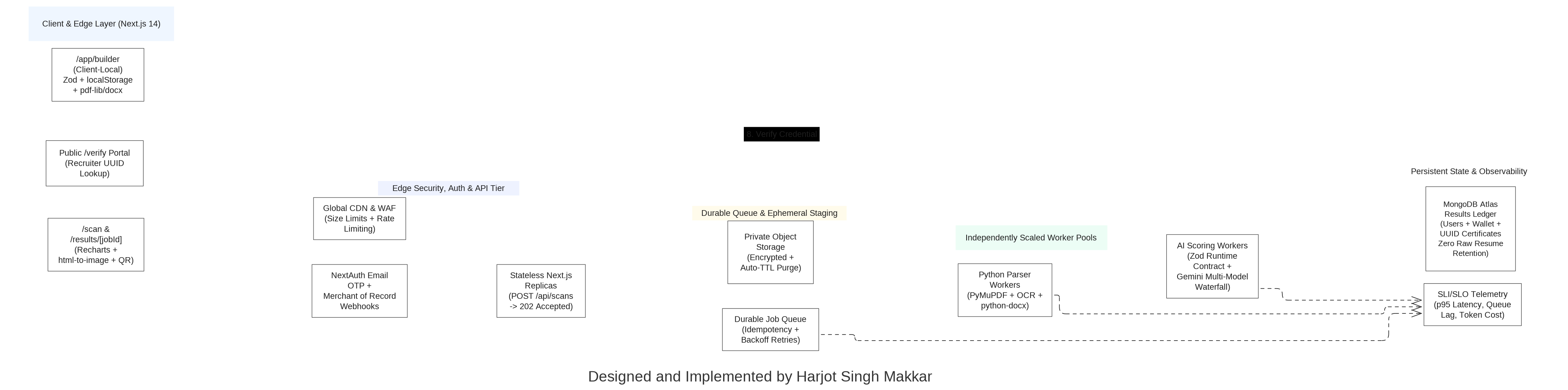
Every architectural boundary reflects an explicit systems-engineering trade-off balancing latency, operational cost, testability, and horizontal scalability:
- Choice: Build /app/builder as a 100% client-side workflow (localStorage + pdf-lib + docx) rather than persisting drafts on a backend database during editing.
- Trade-Off: Resume editing involves high-frequency keystrokes, section reordering, and instant layout previews. Keeping state in React backed by debounced localStorage writes (atscertify.resume) eliminates network latency, avoids database write amplification during drafting, reduces server compute costs for binary PDF/DOCX generation to zero, and provides total user privacy upfront.
- Choice: Offload PDF and DOCX text extraction from Node.js into a standalone Python FastAPI service (POST /parse in src/services/parser/main.py) instead of using pure-JavaScript PDF libraries inside Next.js API routes.
- Trade-Off: Python's PyMuPDF (backed by C-level MuPDF bindings) and python-docx offer significantly faster, higher-fidelity text-layer extraction than Node.js alternatives. Just as importantly, isolating parsing behind an HTTP boundary separates CPU- and memory-intensive binary processing from the I/O-bound Next.js web tier so both can scale independently under load.
- Choice: Wrap LLM evaluation behind a strict AIScoringAdapter TypeScript interface and AIEngineFactory supporting both Google Gemini and a local Ollama endpoint (AI_ENGINE=ollama).
- Trade-Off: Hard-coding a single cloud LLM vendor creates rate-limit fragility and makes local integration testing expensive. The adapter seam allows zero-cost offline testing against local llama3 instances while enabling sequential model fallback (gemini-2.0-flash -> latest -> lite) in cloud environments when upstream 429 (Rate Limit) or 503 (Overloaded) responses occur.
- Choice: Instead of trusting a generative model to output an arbitrary 0-100 match score directly, the Gemini adapter instructs the model to emit itemized deductions in scoreCalculationLog and computes matchPercentage deterministically in TypeScript.
- Trade-Off: LLMs are unreliable at arithmetic and prone to score inflation. Anchoring the final score to explicit, auditable penalty items forces every point deduction to correspond to a concrete structural, keyword, or quantification flaw:
- Choice: Pass the ScoringResult JSON payload from /scan to /results via browser sessionStorage (ats_certify_result) rather than introducing a database in Phase 1.
- Trade-Off: Validates the complete ingestion, parsing, scoring, and Recharts telemetry visualization loop with zero persistent storage of user PII and zero database infrastructure overhead while rapidly iterating on the UI and scoring rubric.
- Single-Source-of-Truth Schema (src/lib/resume/schema.ts): The Resume TypeScript type is inferred directly via z.infer from a Zod schema modeling contact details, professional summary, grouped skills, work experience, projects, education, certifications, and template metadata.
- Debounced Persistence (src/lib/resume/store.ts): On mount, loadResume() hydrates state from localStorage (atscertify.resume); subsequent keystrokes trigger debounced saveResume() writes.
- Sanitization & Validation Gate: Before rendering /app/builder/preview or exporting binaries, sanitizeResume() trims whitespace, strips leading non-alphanumeric bullet characters, and prunes empty entries, while validateResume() enforces summary character bounds, section/bullet caps, email/URL formats, and month/year date patterns.
- Vector Binary Synthesis: ResumePreview renders the single-column ats-classic template, while exportPdf.ts (pdf-lib) and exportDocx.ts (docx) generate clean, machine-readable vector files directly in browser memory.

- Diagnostic Telemetry Surface (/results): Renders high-signal hiring metrics including Auto-Rejection Risk level, Reliability Score gauge, Certification Medal tier, Executive Summary, Impact Score, Years of Experience, Lexical Depth, Volumetric Density, Fluff-vs-Fact ratio, Recharts keyword bar charts and radar benchmarks, Strategic Directives, Technical Alerts, and Missing Keywords.
- Client-Side Artifact Export & Storage Resiliency: Integrates html-to-image to export the full diagnostic dashboard as a downloadable PNG report, while wrapping sessionStorage and localStorage calls in defensive try/catch blocks to intercept DOMException errors in hardened browsers without triggering a React crash.
To treat this case study with genuine systems-engineering rigor, it is critical to separate what works in the current prototype from the bottlenecks that would fail under production traffic:
- Current Prototype Behavior: Synchronous POST /api/scan (maxDuration = 300) blocks while uploading, parsing, and waiting on LLM inference.
- Production Failure Mode: Ties up serverless/web connections during slow model responses; any transient client network drop loses in-flight work.
- Production Solution: Shift to non-blocking asynchronous job submission (202 Accepted returning a jobId), queue-based execution, and Server-Sent Events (SSE) status updates.
- Current Prototype Behavior: FastAPI URL is hard-coded to http://127.0.0.1:8000/parse in app/api/scan/route.ts (and Ollama to 127.0.0.1:11434).
- Production Failure Mode: Loopback addressing assumes co-located local processes and fails completely across isolated container hosts or Kubernetes pods.
- Production Solution: Externalize endpoints into validated environment variables with DNS-based service discovery and explicit AbortController timeouts.
- Current Prototype Behavior: localStorage (atscertify.resume) and sessionStorage (ats_certify_result) only; zero database infrastructure.
- Production Failure Mode: Reports cannot be shared across devices, expire when sessions clear, and large payloads risk browser storage quota exhaustion.
- Production Solution: Introduce authenticated tenant-scoped storage in MongoDB Atlas acting as an immutable Results Ledger with zero raw resume text retained.
- Current Prototype Behavior: JSON.parse checked against compile-time TypeScript ScoringResult; total provider failure returns a synthetic zero-score object.
- Production Failure Mode: Malformed LLM JSON fields are not caught by a runtime schema validator, and provider outages can render in the UI as completed 0% scores.
- Production Solution: Enforce a runtime Zod safeParse boundary on model output before returning, and replace synthetic zero-score fallbacks with explicit completed, partial, and failed job states.
- Current Prototype Behavior: Reads entire upload into memory; PDF extracts selectable text (no OCR) and DOCX reads paragraphs (skipping tables and headers).
- Production Failure Mode: Unbounded uploads risk container memory exhaustion; scanned image PDFs yield empty text, and table-formatted DOCX resumes lose entire sections.
- Production Solution: Enforce multi-layer upload byte caps, magic-byte file-signature verification, selective OCR fallback (PyMuPDF + Tesseract/RapidOCR), and full XML traversal of DOCX tables.
- Current Prototype Behavior: /results CTA linked to /builder instead of /app/builder; npm test invoked node --test on TypeScript files using @/ path aliases.
- Production Failure Mode: Route mismatch causes 404 navigation errors from the results CTA; Node test runner requires a TypeScript/alias loader in CI.
- Production Solution: Align internal routing contracts and configure standard module alias resolution in the CI test harness.
Scaling ATS Certify from a single-user local prototype to 1 million users requires modeling capacity around active scan arrival rates and queue concurrency rather than headline user counts:
- Daily Scan Volume: Assuming 1,000,000 DAU averaging 0.2 scans/day = 200,000 scans/day.
- Average Arrival Rate: 200,000 / 86,400 = ~2.31 scans/second.
- Peak Arrival Rate: Under a 20x job-season or viral surge factor = ~46.3 scans/second.
- Concurrent In-Flight Scans: If an unoptimized synchronous scan requires 15 seconds end-to-end: in_flight_scans = 46.3 * 15 ≈ ~695 concurrent in-flight scans This concurrency level would immediately exhaust serverless HTTP connection pools and trigger aggressive upstream LLM rate-limit rejections (HTTP 429).
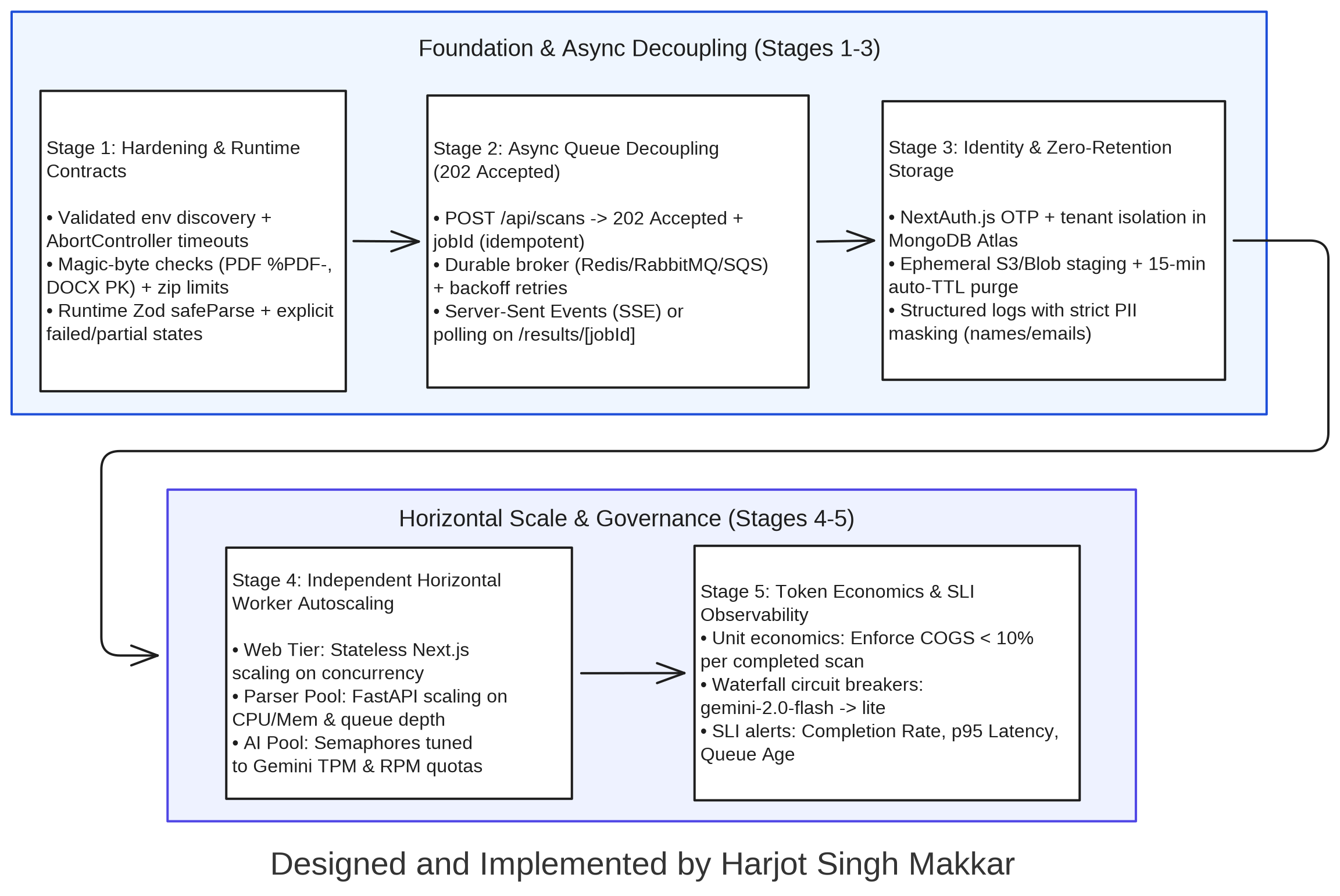
Ahead of the planned mid-to-late 2027 production launch, ATS Certify is scoped to evolve across four major pillars:
- Privacy-First Results Ledger: Raw resume binaries and extracted text remain strictly ephemeral, processed in memory and purged immediately after evaluation. A serverless MongoDB Atlas cluster acts exclusively as a Results Ledger, storing User, Wallet, and Certificate documents indexed on userId, email, and createdAt with zero raw resume text retained.
- Verifiable UUID Credentials: Qualifying scans mint an unguessable UUID (certificate_id) and embed a verification QR code (qrcode.react) into exported reports, allowing recruiters to verify score authenticity via the public verification portal.
- Automated X-Y-Z Remediation: Instead of leaving candidates to manually fix flagged weaknesses, the Phase 3 AI Master Builder will ingest the diagnostic penalty log from /results and rewrite weak bullets using the Google X-Y-Z achievement formula:
"Accomplished [X] as measured by [Y], by doing [Z]" The engine then automatically exports a newly validated, 100% ATS-parseable PDF or DOCX file.
- Zero-Friction Authentication: Passwordless Email OTP authentication powered by NextAuth.js and Resend.
- Pay-Per-Action Credit Wallet: Replaces high-friction monthly subscriptions with an internal credit wallet backed by a Merchant of Record (Lemon Squeezy) to handle global VAT/tax compliance and localized Purchasing Power Parity (PPP) pricing across three tiers:
- Teaser Scan (Free): Executes the scan pipeline with blurred granular diagnostics to prove value upfront.
- Full Neural Scan: Unlocks complete structural penalty logs, keyword gaps, and radar benchmarks.
- AI Master Builder: Generates an X-Y-Z rewritten, ATS-verified PDF/DOCX resume.
- Hybrid OCR & Complex DOCX Traversal: Upgrade src/services/parser/main.py with selective OCR fallback (PyMuPDF + Tesseract/RapidOCR) for image-based PDFs and full XML traversal of DOCX tables, headers, and footers.
- Job Description Scraper & Browser Extension: Automated JD ingestion for role-specific skill-gap analysis, a browser extension for one-click job-board matching, and an Admin Command Center tracking scan latencies, token costs, and ledger telemetry.
Next.js 14 · Python FastAPI · PyMuPDF · Google Gemini API · Ollama · TypeScript · Zod · pdf-lib · python-docx · Recharts · Framer Motion · System Design · SRE