Deep-Dive Case Study: For the complete production migration from ingress-nginx to Envoy Gateway v1.7.0 with FluxCD GitOps, Gatekeeper policy debugging, and zero dropped requests, read Zero-Downtime Migration from ingress-nginx to Envoy Gateway v1.7.0.The core rule of ingress migration is straightforward: never couple controller installation with traffic cutover. Separate provisioning, route translation, and traffic shifting into distinct operational phases: Install Envoy Gateway into a dedicated namespace (envoy-gateway-system) while leaving your existing ingress-nginx controller and all Ingress resources completely untouched. At this stage:
- The GatewayClass (eg) and Gateway objects are instantiated.
- The cloud provider provisions a separate external LoadBalancer IP for Envoy.
- Zero production traffic reaches Envoy Gateway.
- Platform engineers validate Envoy's internal readiness by issuing curl requests directly to the new LoadBalancer IP with explicit Host headers.
- Update DNS records (or your external global load balancer) using weighted routing:
- Shift 10% of traffic to Envoy's LoadBalancer IP.
- Monitor error rates (502/503/504), p99 latency, and TLS handshake metrics.
- Incrementally increase the weight: 25%, 50%, and finally 100%.
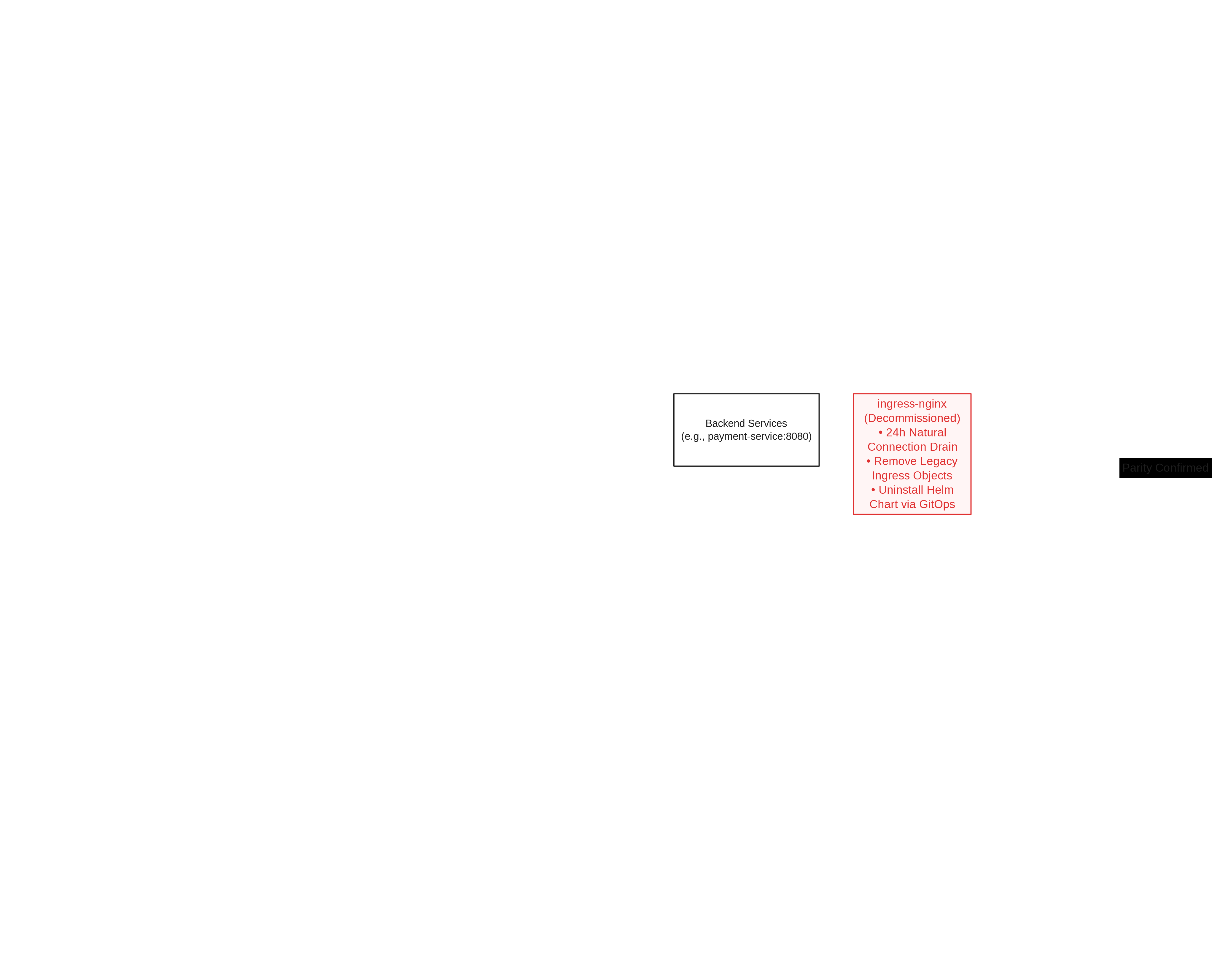
- Once 100% of traffic resolves to Envoy Gateway, allow existing connections on ingress-nginx to drain naturally over a 24-hour observation window.
- Remove legacy Ingress resources and uninstall the NGINX controller Helm chart via GitOps.
- Downstream 5xx Error Spikes: Real-time alerts on any non-zero rate of 502 Bad Gateway or 504 Gateway Timeout responses.
- Latency Distribution Shifts: Comparing p95 and p99 response times between NGINX and Envoy data planes.
- TLS Handshake Failures: Confirming that SNI negotiation and certificate chains match client expectations.
- Upstream Connection Churn: Verifying that Envoy connection pooling maintains stable keep-alive connections to backend pods.
- A hard cutover trades safety for speed: Parallel routing takes longer to plan, but it guarantees a deterministic, zero-downtime cutover with instant rollback capability.
- Never rely on automatic annotation translation: Gateway API filters differ fundamentally from NGINX annotations. Map routes explicitly and test edge cases (header limits, CORS, path rewrites) before routing traffic.
- Master the escape hatch: Standard Gateway API resources cover 90% of routing needs. For enterprise tuning (such as 512k header buffer sizes), tools like EnvoyPatchPolicy provide the necessary low-level control without abandoning declarative GitOps.